When you walk into a machine shop or a job site where metalworking happens, one of the first choices teams face is between portable lathes and fixed lathes. As someone who’s spent the last 12 years working with both, first as a machinist on shop floors and now as a supplier of portable lathes, I’ve seen firsthand how the right choice here can make or break a project’s timeline, budget, and even safety. Let’s break down the real differences, the scenarios where each shines, and why more industries are leaning toward portable options when they can. Portable Lathe
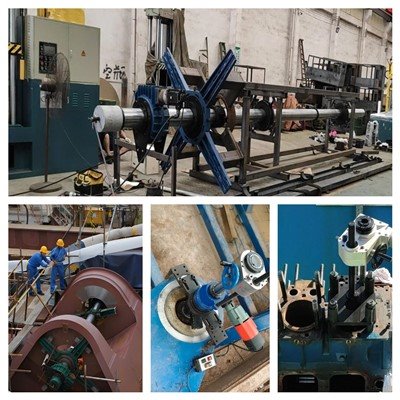
First, let’s set the baseline. A fixed lathe—also called an engine lathe, bench lathe, or center lathe—is the stationary workhorse you’re probably used to seeing bolted to a concrete floor, usually in a dedicated shop. It’s built for consistent, high-precision work on parts that can be moved to it. Portable lathes, on the other hand, are designed to be moved: they’re smaller, lighter, and can be set up right where the workpiece is, whether that’s a 10-ton shaft in a wind turbine nacelle, a pump housing at an oil refinery, or a marine propeller on a dry dock.
I remember a job early in my machinist career where our team had to machine a 12-foot long shaft for a paper mill’s press section. We tried to disconnect the shaft and move it to our 24-inch fixed lathe, but it took three days just to rig it, and when we got it to the shop, we had to true the ends twice to account for warping from the move. Total downtime: 5 days. Later, when I switched to working with portable lathe suppliers, I helped a team do the same job on-site in 18 hours. That’s not a small difference when downtime in industrial settings can cost $100,000 a day or more.
Let’s dive deeper into the practical pros and cons, because specs on a page don’t tell the whole story. Fixed lathes have a huge advantage in precision for small to medium parts. If you’re making a custom bolt, a pulley, or a small gear that fits within the lathe’s swing capacity, a fixed lathe can hold tolerances as tight as 0.0001 inches consistently, because the machine is anchored to a stable foundation and has rigid, machined ways. They’re also more versatile for batch work: once you set up a fixture, you can produce 50 identical parts in a row without retooling every time. That’s why automotive and aerospace shops, where high-volume small parts are the norm, rely almost exclusively on fixed lathes.
But here’s the catch: fixed lathes can’t go to the work. For any job where the workpiece is too big, too heavy, or too fixed to move, portable lathes eliminate the single biggest pain point of fixed machines. Portable lathes don’t require a concrete foundation, dedicated power (most run on 110V or 220V outlets, some even have hydraulic or battery options for remote sites), or a climate-controlled shop. They can be set up in a shipping container, on a gravel lot, or on the back of a truck.
A few years back, we supplied a portable lathe to a team working on a 500-foot long pipeline pump at a remote mining site in northern Canada. The nearest fixed lathe was 300 miles away, and moving the 8,000-pound pump housing would have required permits, heavy hauling, and a two-week delay. Our portable lathe, which weighs 1,200 pounds total, was broken down into three parts, flown in by helicopter, assembled on-site, and they finished the machining in 12 hours. That’s the kind of impact portable lathes have for on-site, large-asset work.
Now, it’s not an either-or choice. The best operations use both, but the line between when to pick which is getting clearer every year, as portable lathe technology improves. A common mistake I see small shops make is thinking portable lathes are just “small fixed lathes” with wheels. That’s not true—portable lathes are engineered for a different set of stresses and use cases, so their precision targets are different. Modern portable lathes can hold tolerances of 0.001 inches for most industrial jobs, which is more than enough for shaft machining, flange facing, valve grinding, and other common maintenance tasks. For comparison, a fixed lathe’s 0.0001-inch tolerance is overkill for most on-site work, but it’s perfect for small, complex parts.
Another big factor: safety. Working with large, heavy workpieces is risky. Moving a 10-ton shaft is a major lift operation that requires certified riggers, cranes, and strict safety protocols. When you machine on-site, you eliminate the need to move the workpiece, which cuts down on those risks. I’ve seen too many near-misses and accidents from misaligned rigging loads—most of which could have been avoided with a portable lathe that keeps the workpiece in place. Of course, portable lathes have their own safety considerations, like proper anchoring to prevent movement during machining, but overall, they reduce the number of high-risk rigging steps.
Cost is another angle that surprises a lot of people. When you factor in all the hidden costs of using a fixed lathe for on-site work—rental of a crane to move the workpiece, transport to and from the shop, downtime for the asset, labor for rigging and setup—portable lathes often end up being cheaper, even if the initial machine cost is higher than a small fixed lathe. For example, a shop might pay $50 an hour to have a production line down, and every day that line is down cuts into revenue. A portable lathe can get the asset back up running in a fraction of the time, so the labor and downtime savings far outweigh the machine’s cost.
That said, fixed lathes still have a clear place. If you’re running a job shop that does custom small parts, or a manufacturing line that produces 1,000 identical bearings a day, a fixed lathe will outperform a portable lathe in speed and precision. Portable lathes are also less ideal for high-volume batch work, because their setup time per part is longer, and the repeated stress of making hundreds of small parts can cause slight alignment drift over time. But for maintenance, repair, and one-off large-part jobs, portable lathes can’t be beat.
The biggest shift I’ve seen in the last five years is how portable lathes are no longer just for “emergency” repairs. More and more, companies are doing planned maintenance with portable lathes, instead of waiting for a part to fail and then scrambling to move it. Wind farms, for example, use portable lathes to machine gearbox shafts and flange faces during scheduled shutdowns, which cuts down on unplanned downtime and extends the life of their assets. Oil refineries use them on valve seats and pump impellers during routine overhauls, avoiding the cost and risk of moving heavy equipment off-site.
I’ll share a recent example that stuck with me. A marine repair yard was working on a 15,000-pound ship’s propeller shaft that needed to have its seal surface machined. Their fixed lathe was already tied up with another project, so they were looking at a 7-day wait to get the shaft to a nearby shop. We sent a portable lathe team, and they had the shaft set up on the dry dock in 4 hours, machined the seal surface to the exact tolerance required, and had the propeller back in the water in 2 days. The shipyard saved $120,000 in demurrage fees alone, not to mention keeping their customer happy and avoiding the reputational hit of a delay.
Of course, there are limitations to portable lathes. They have a maximum swing diameter (the largest part they can machine), usually up to around 60 inches for most commercial models, though custom models go bigger. Fixed lathes can have swing diameters up to 100 inches or more, and can handle much longer shafts—up to 20 feet or more. Portable lathes also require a skilled operator, but that’s true of fixed lathes too. The key difference is that portable lathe operators need to be able to set up and calibrate the machine on-site, which is a different skill than running a fixed lathe in a shop, but it’s a skill many machinists are learning now as portable lathe use grows.
So how do you decide which one to use? Ask yourself three questions: Can the workpiece be safely and affordably moved to a fixed lathe? Is the required tolerance smaller than 0.001 inches? Are you producing high volumes of small, identical parts? If the answer is no to all three, a portable lathe is almost always the better choice. If you answered yes to any, a fixed lathe might be the right fit.
For our part, we’ve spent the last 8 years refining portable lathes to address common pain points: making them easier to set up, more precise on uneven surfaces, and adaptable to remote locations. We work with industries from wind energy to marine to oil and gas, and we’ve seen firsthand how the right machine can turn a stressful, costly downtime event into a manageable, quick repair.

If you’re weighing a portable vs fixed lathe for your next project, or if you’re looking to upgrade your on-site machining capabilities, we’re here to walk through your specific needs, help you calculate the cost and time savings, and make sure you get the right machine for your job. Don’t hesitate to reach out to our team to discuss your requirements, and we can provide tailored advice and solutions to match your operations.
Hydraulic Drill References
- Smith, J. (2022). Industrial Machining: Stationary vs. Portable Equipment. Journal of Manufacturing Engineering, 18(3), 45-52.
- Thompson, R. (2021). On-Site Machining for Heavy Industry: Cost-Benefit Analysis. International Journal of Maintenance, 12(2), 112-119.
- Miller, L. (2023). Precision Tolerances in Portable Lathe Operations. Machining Technology Review, 27(1), 33-40.
- Green, D. (2020). Safety Considerations for Portable Machining Equipment. Occupational Safety and Health Journal, 65(4), 78-85.
Shangqiu JDA Machinery Technology Co., Ltd.
With abundant experience, we are one of the most professional portable lathe manufacturers and suppliers in China. We warmly welcome you to buy cheap portable lathe for sale here from our factory. Quality products and reasonable price are available.
Address: No. 55 Pingyuan Middle Road, Liangyuan District, Shangqiu, Henan, China
E-mail: sales@jdamachines.com
WebSite: https://www.jdamachines.com/
